

Simon Jenner
Tuesday 3 March 2026
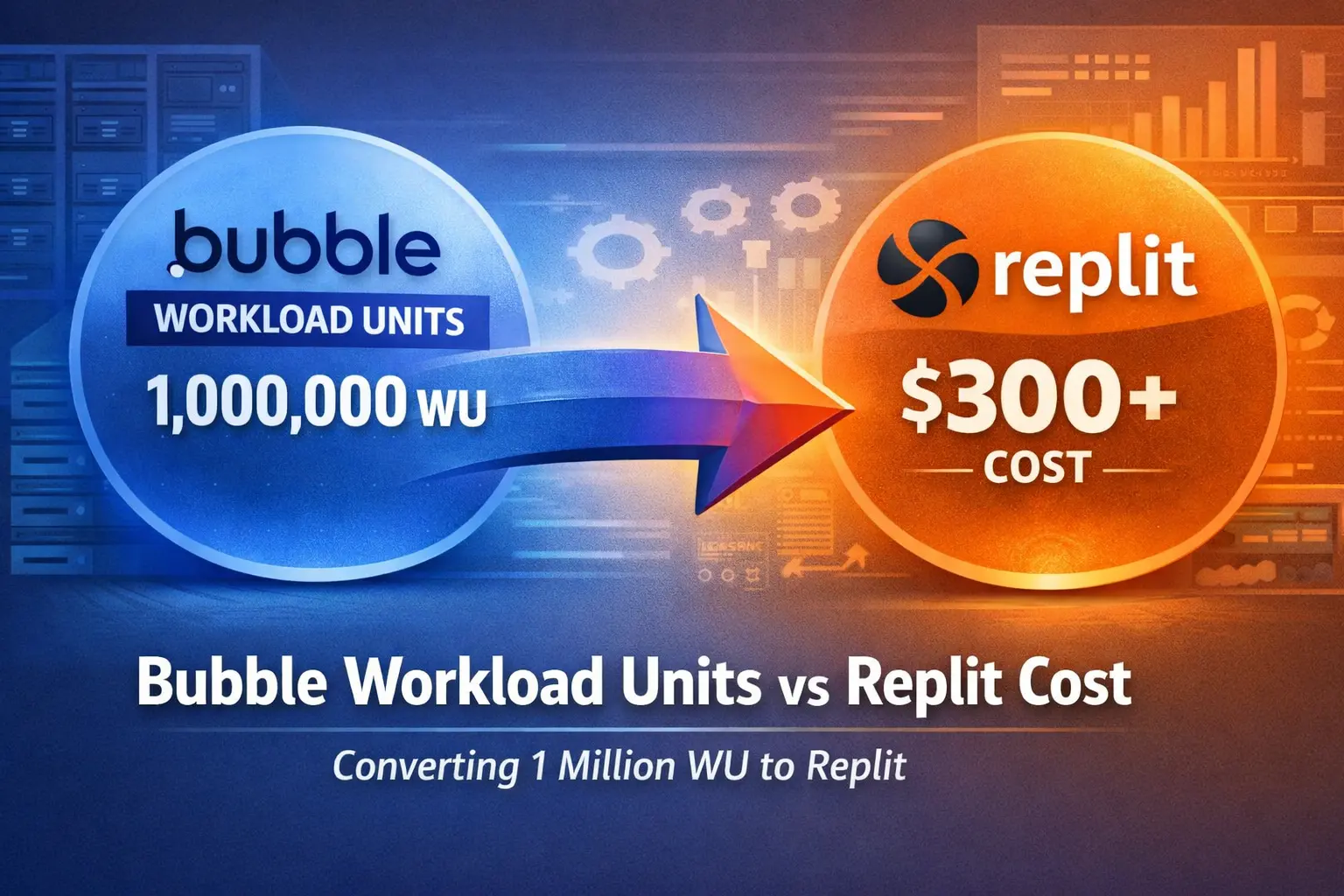
If you’re comparing Bubble.io vs Replit pricing, understanding how Bubble Workload Units (WU) translate to Replit’s usage-based billing is essential. Bubble bundles backend compute, database operations, API calls, and infrastructure into a single WU metric. Replit, however, charges separately for compute units, requests, bandwidth, and database usage. Based on published pricing, 1 million Bubble WU (about $300 in overage costs) equates to roughly 94 million Replit compute units — or approximately $300 in compute charges before additional request and bandwidth fees. While not an exact technical conversion, this pricing-based comparison gives founders and developers a realistic baseline when estimating migration costs from Bubble.io to Replit.
Posted in:
No-Code
If you're evaluating a migration from Bubble.io to Replit, one of the biggest questions is:
How do Bubble Workload Units (WU) translate into Replit’s usage-based billing?
Because the two platforms measure backend usage differently, there’s no official conversion formula. However, by analysing how each platform prices infrastructure, we can derive a realistic cost comparison.
This guide breaks down:
How Bubble Workload Units work
How Replit measures usage
A practical WU → Replit conversion
What 1 million Bubble WU would cost on Replit
When Replit may be cheaper — or more expensive
What Are Bubble.io Workload Units (WU)?
Bubble uses Workload Units (WU) to measure backend activity.
Unlike traditional cloud platforms that bill separately for compute, memory, bandwidth, and requests, Bubble bundles everything into a single metric.
A Bubble WU typically includes:
Backend workflow execution
Database reads and writes
API calls
Server processing time
Internal routing
Infrastructure overhead
This makes Bubble pricing simple but difficult to predict.
Bubble Overage Pricing
Bubble’s published overage rate is:
$0.30 per 1,000 Workload Units
That means:
1 million Bubble WU costs approximately $300.
How Replit Pricing Works
Replit uses usage-based billing, but unlike Bubble, it meters resources separately.
1️⃣ Compute Units
Replit’s core infrastructure metric is the Compute Unit, which blends CPU and RAM usage.
Replit defines:
1 CPU-second = 18 compute units
1 GB-second of RAM = 2 compute units
Price:
$3.20 per 1,000,000 compute units
$1/month base deployment fee
2️⃣ Additional Replit Billing Meters
Replit may also charge for:
HTTP requests
Outbound data transfer (bandwidth / egress)
Database usage (depending on plan)
This is a key difference:
Bubble bundles everything into WU.
Replit separates everything into individual meters.
Can You Convert Bubble WU to Replit Compute Units?
There is no official technical formula because:
Bubble does not publish how WU maps to CPU-seconds.
WU is a proprietary blended metric.
Replit meters physical resource consumption.
However, we can derive a pricing-based equivalence.
Converting 1 Million Bubble WU to Replit Cost
Step 1: Bubble Baseline
1,000,000 WU = $300
Step 2: Replit Compute Pricing
$3.20 per 1,000,000 compute units
Step 3: Convert Dollars to Compute Units
$300÷3.20=93.75\$300 \div 3.20 = 93.75$300÷3.20=93.75
Or simplified:
1 Bubble Workload Unit ≈ 94 Replit Compute Units
Final Cost Estimate
If we look at compute only:
94,000,000 compute units
× $3.20 per 1M
= ~$300 in Replit compute cost
Add the $1 base fee:
~$301 total compute cost
Important: Real-World Cost Differences
This estimate assumes Bubble WU ≈ Replit compute cost.
But in practice:
App Type | Likely Outcome on Replit |
|---|---|
CPU-heavy backend | Similar cost |
High request volume | Likely higher cost |
High outbound bandwidth | Likely higher cost |
DB-heavy workload | Depends on database plan |
Because Bubble bundles everything, high-request or high-bandwidth apps may cost more on Replit if those meters are significant.
When Replit Might Be Cheaper
Replit may be more cost-efficient if:
Your app is CPU-efficient
You optimize database queries
You reduce unnecessary API calls
You minimize outbound bandwidth
Developers with optimised backends often see lower marginal infrastructure costs than no-code platforms.
When Bubble Might Be Simpler
Bubble may be preferable if:
You want fully predictable blended billing
You don’t want to manage infrastructure trade-offs
Your traffic patterns fluctuate significantly
You prefer bundled scaling economics
The Bottom Line
There is no exact WU → CPU conversion formula.
But using published pricing as an anchor:
1 million Bubble.io Workload Units = ~$300 of Replit compute usage
That gives founders and developers a practical budgeting baseline when comparing Bubble.io vs Replit costs.
How to Get a More Accurate Estimate
The best method is empirical:
Identify 5–10 common user flows in Bubble.
Measure WU consumption.
Recreate them in Replit.
Record:
Compute units
Requests
Outbound data transfer
Model your real workload.
This will outperform any theoretical conversion.
Need more help
Million Labs is a Bubble.io Gold Partner and Replit Partner so can help you with the migration decision.
Reach out to us for a chat
Ready to launch your startup idea with an MVP?
Download our step by step guide for non-technical founders to create a startup Minimum Viable Product (MVP)
Get the eBook